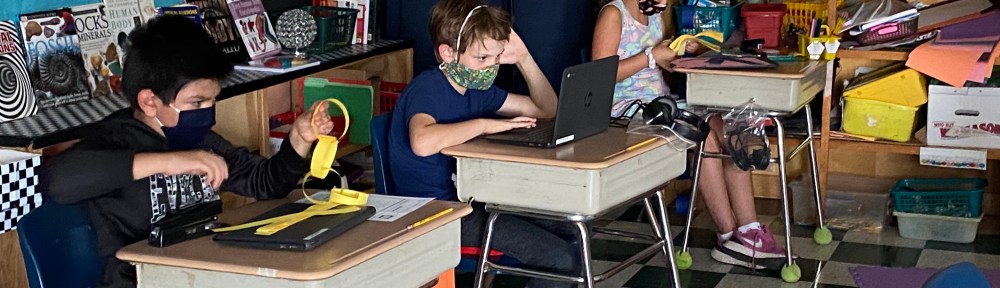
This was the second week of full in-person instruction. Now that the students have adjusted, they appear to be settled in their environment and soothed by their new access to learning. We’ve been diving deeper into academics. These young humans are sponges and thirsty to learn meaningful content. The pump is primed to see them as writers.
This morning I am thinking about the writing process. If presented in a certain way, it can either open doors or slam them shut. If my years of teaching writing have taught me anything, it’s that writing is a behavior. It is a production that is constrained by a sense of worthiness. Never is a learner more vulnerable than when they put their thoughts to words for all to critique. I am mindful of this initiation process and I always try to treat it with kid gloves.
The process of creating a story begins with thoughts. These thoughts are easily accessed in pictures. The pictures create an order and offer more thoughts about the significance of the pictures. Putting words to match the pictures is a sensible process and far less intimidating if a writer feels unable to describe (or remember enough to describe) their visualization.
The need to approach formal writing with access for all learners, has lead me to use a variety of pre-writing experiences. I fully expect that few children will be comfortable enough to sit down and take to a task as ominous as “describe a time spent with friends and what you learned” and expect there to be a full display of skills that fit neatly into a spectrum which accurately advises a course of instruction. That type of screening is an okay tool, but if used too often it can reinforce the intimidation, and I find it to do more harm than good.
This year I will approach writing readiness through thoughts, images, words, and grammar.
Thoughts: I will encourage students to record themselves telling a story without writing. Story telling is an art form, and we can listen to some podcasts and videos to see how story tellers use a format to build tension.
Images: I will be using comic strip templates and story mountains so that students who struggle to capture their ideas can add details in pictures. These details serve as a memory device so the story teller can observe the cause and effect changes they are imagining.
Words: The thoughts and images can be interpreted into English and recorded to show details.
Grammar: Students can use their recordings to notice inflection points of language and listen for cues and make adjustments for clarity. Grammar will be introduced as coding of the English language that makes interpretation more of a sport than a chore. (I predict this class will love that!)
Our current situation also makes me more mindful that I need to use technology to our advantage. I’ll use our in-person time to teach these skills so that we can adjust to remote learning without having to water down quality.
With this window of time, I aim to introduce my students to the gift of the story teller in their own head and the art of putting it in print.
It’s a tall order, but game on.
 The Tibbetts Tribe